

Food Packaging Equipment Guide: Matching Machines to Food Products
Food products vary in shape, weight, texture, and packaging requirements. A biscuit, bread product, snack, or frozen food cannot always use the same packaging approach.
The most effective equipment selection starts with the product and works toward the final package.
Product Characteristics Come First
Before choosing food packaging equipment, manufacturers should understand how the product behaves during feeding, wrapping, sealing, and handling.
Regular products are generally easier to align and feed automatically. Fragile products require more controlled handling, while loose products may need a completely different packaging method.
Package size and production volume also influence the equipment configuration.
|
Product characteristic |
Equipment consideration |
|
Regular individual product |
Horizontal flow wrapping |
|
Fragile product |
Controlled feeding and handling |
|
Loose or granular product |
Vertical packaging |
|
Multiple product sizes |
Flexible machine configuration |
|
High production volume |
Automated continuous packaging |
|
Secondary packaging required |
Cartoning or case packing |
This product-based approach helps manufacturers narrow down the appropriate packaging technology before comparing individual machine models.
Bakery Products and Biscuits
Bakery products represent a broad packaging category, ranging from rigid biscuits to soft bread and delicate pastries.
Biscuits and Cookies
Biscuits and cookies are often suitable for horizontal flow wrapping because many products have regular shapes and can be continuously fed into the packaging machine.
The main challenge changes when products are thin or fragile. Product positioning and transfer need to remain stable throughout the packaging process to reduce breakage and inconsistent package presentation.
Factories producing multiple biscuit sizes should also consider changeover efficiency. The packaging system needs to support different dimensions without creating excessive downtime.
Bread and Soft Bakery Products
Bread and soft bakery products require a different approach.
Their texture means that excessive pushing or uncontrolled transfer can affect product appearance. Feeding equipment and product handling should therefore be considered together with the flow wrapper.
Soontrue provides automatic bakery packaging solutions, including equipment designed for continuous food packaging applications. More information is available in Food Automatic Packaging Solutions.
Snacks and Confectionery
Snack products can have very different physical characteristics.
Snack bars, individually shaped confectionery products, and similar items can often be considered for horizontal flow wrapping. Loose snacks such as nuts, chips, and other granular products may be more suitable for vertical packaging.
The difference comes from the way the product is supplied to the machine.
A product that can be positioned individually fits naturally into a horizontal wrapping process. Loose products that are measured by weight or volume require a different feeding and forming process.
Matching the Package to the Product
The package format should also be considered.
An individually wrapped snack bar has different requirements from a multi-product bag. A manufacturer may therefore need to evaluate not only the primary packaging machine but also the feeding and grouping system.
This becomes especially important when the same production line handles several SKUs.
Frozen Food and Seafood
Frozen food packaging introduces additional considerations related to product condition, sealing, film, and handling.
Frozen vegetables, seafood, dumplings, and other frozen foods can vary significantly in size and shape.
Some products are loose and require vertical bagging, while others are individually formed and may be considered for horizontal packaging.
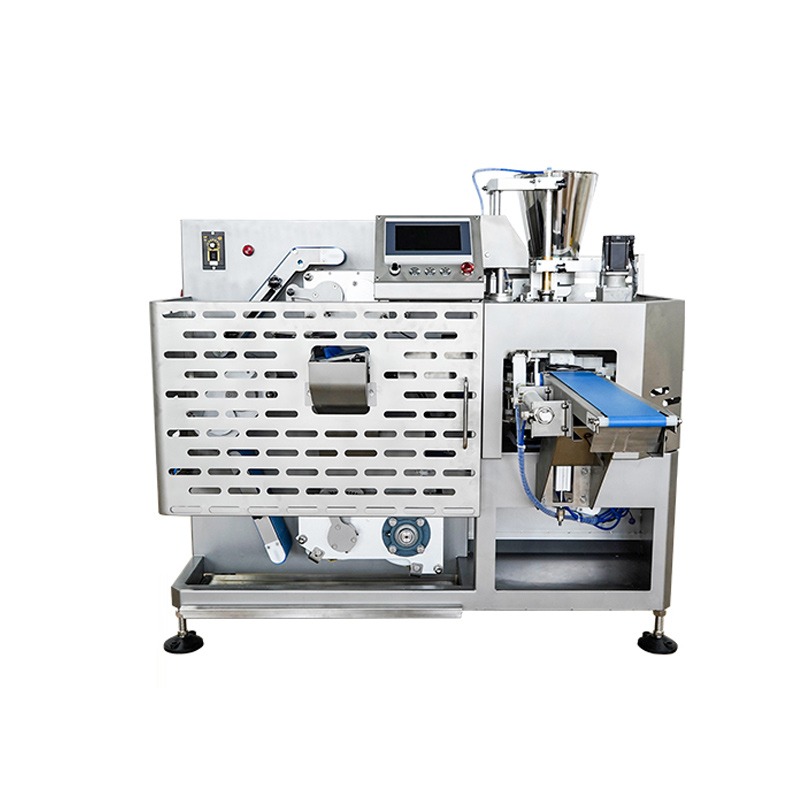
The packaging system should maintain consistent product feeding while creating reliable seals suitable for the selected packaging material.
For factories working with fresh and frozen products, Soontrue also provides related automation solutions. See Automation in Fresh and Frozen Food Packaging Lines for more information.
Choosing Between Horizontal and Vertical Packaging
The basic difference can be understood from the product format.
|
Packaging approach |
More suitable starting point |
|
Horizontal flow wrapping |
Individual, regularly shaped products |
|
Vertical packaging |
Loose, granular or free-flowing products |
|
Customized feeding |
Irregular or difficult-to-handle products |
|
Secondary packaging |
Products requiring cartons or cases |
This is not a fixed rule for every food product. Product dimensions, feeding method, target output, package size, film, and factory layout still need to be evaluated.
The Flow Packing Machine provides additional information about Soontrue's flow wrapping technology.
Primary Packaging Is Only One Part of Automation
Many factories focus first on the primary packaging machine and then discover that manual work remains at the next stage.
For example:
Food Product → Flow Wrapper → Manual Cartoning → Manual Case Packing → Manual Palletizing
The primary packaging process may already be automated, but operators still need to transfer, count, load, and stack products.
For higher levels of automation, downstream equipment can be introduced to connect the complete workflow.
Cartoning
Cartoning machines can automate the process of loading packaged products into cartons.
This can be useful for products that require organized secondary packaging before shipment or distribution.
Case Packing
Case packing extends automation beyond individual packages or cartons.
Instead of manually placing finished products into shipping cases, automated case packing equipment can handle repetitive case-loading tasks as part of a larger packaging system.
Robotic Palletizing
At the end of the line, robotic palletizing can automate repetitive pallet-loading operations.
A more complete packaging workflow can therefore become:
Primary Packaging → Cartoning → Case Packing → Robotic Palletizing
The exact configuration depends on the product, production volume, packaging format, and factory requirements.
Matching Equipment to Production Scale
Equipment selection should also reflect how the factory operates.
A small food producer with a limited number of SKUs may prioritize simple operation and flexibility. A high-volume manufacturer may place greater emphasis on continuous production, automation, and integration.
|
Production situation |
Main priority |
|
Small production volume |
Flexible and easy operation |
|
Multiple SKUs |
Fast and practical changeover |
|
High-volume production |
Stable continuous output |
|
Growing production |
Scalable automation |
|
Fully automated factory |
Integrated packaging line |
This helps prevent over-investment in equipment that the current production process does not require.
Building a Complete Food Packaging Line
For larger food manufacturers, the packaging system can be planned from the product preparation stage through to palletizing.
A typical workflow may include:
Product Feeding → Primary Packaging → Inspection → Cartoning → Case Packing → Palletizing
Each stage should be compatible with the next.
For example, increasing the speed of a flow wrapper does not necessarily increase total line output if the cartoning machine or case packing equipment cannot handle the same production rate.
Line balance therefore becomes more important as automation increases.
Information for a Packaging Equipment Evaluation
Manufacturers can speed up the equipment selection process by preparing basic production information.
Useful information includes product photos, dimensions, weight, target package size, film type, production capacity, number of SKUs, and existing equipment.
A production video can also help demonstrate how the product is currently fed and handled.
This gives the equipment manufacturer a practical basis for evaluating the packaging process rather than making a recommendation from product names alone.
Soontrue Food Packaging Solutions
Soontrue provides automatic packaging machinery covering flow wrapping, vertical packaging, cartoning, case packing, palletizing, and related food packaging applications.
This range allows manufacturers to evaluate primary packaging and downstream automation together.
For food producers planning a new line or upgrading an existing packaging process, the right solution should be based on the product, package format, production target, and desired level of automation.
Conclusion
Food packaging equipment should be selected according to the product, package format, production scale, and automation requirements. From flow wrapping and vertical packaging to cartoning, case packing, and palletizing, Soontrue provides equipment options for building more complete food packaging workflows. Contact Soontrue with your product information and production requirements to discuss the right packaging equipment for your factory.
FAQs
Which food products are commonly suitable for flow wrapping?
Many individually shaped food products, including biscuits, bakery products, snack bars, and similar products, can be considered for flow wrapping. The final machine configuration depends on the product and packaging requirements.
Are loose snacks suitable for a horizontal flow wrapper?
Loose products are often better suited to vertical packaging because they can be weighed and dropped into a formed bag. The final choice depends on the product and package format.
Can one food packaging line handle several products?
A line can sometimes be configured for multiple products, but product dimensions, feeding requirements, film, package sizes, and changeover conditions need to be considered.
When is a cartoning machine useful?
Cartoning becomes valuable when individually packaged food products need to be automatically grouped and placed into cartons for secondary packaging.
Can food packaging equipment be integrated with existing machinery?
Integration depends on the existing machine interfaces, product flow, factory layout, and control requirements. These factors should be reviewed before equipment installation.
Does Soontrue provide complete food packaging solutions?
Soontrue provides multiple packaging machine categories that can be combined according to the production requirements, from primary food packaging through secondary and end-of-line automation.