

Why Do Packaging Machine Seals Fail?
Issues on food production lines—such as insecure seals, wrinkled film, air leaks, or product residue in the sealing area—often lead to packaging waste and quality risks. Identifying the root cause before adjusting machine parameters helps prevent recurring defects and reduces unnecessary downtime.
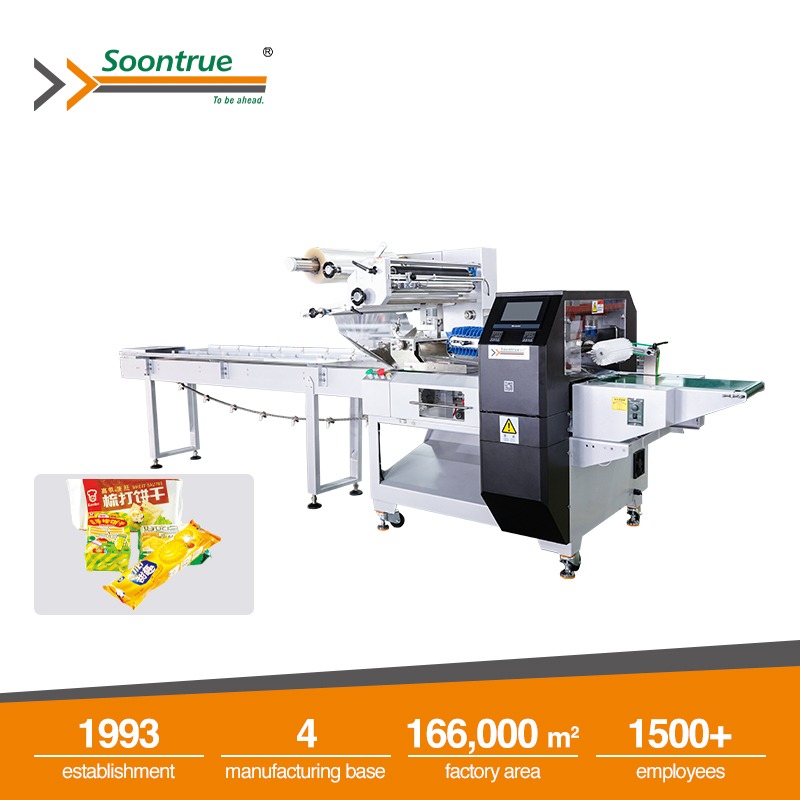
Soontrue offers tailored flow-wrapping (pillow-pack) solutions designed for a wide range of food products and specific production requirements. Understanding the common causes of seal failure enables manufacturers to accurately pinpoint the source of a problem.
Common Sealing Problems in Food Packaging
Sealing defects can affect package integrity and product shelf life. Identifying the defect pattern helps narrow down the possible causes.
|
Sealing problem |
Common signs |
Potential impact |
|
Weak or incomplete seals |
Open edges or uneven bonding |
Package leakage and reduced protection |
|
Wrinkles and uneven sealing |
Folded film or irregular seal lines |
Weak spots and inconsistent package quality |
|
Product contamination |
Crumbs, oil, or powder in the seal area |
Incomplete bonding and potential leak paths |
Weak or Incomplete Seals
A weak seal may look intact but separate easily during handling, while an incomplete seal has visible gaps or sections that have not bonded properly. These defects may result from unsuitable sealing conditions, film incompatibility, or uneven contact between sealing surfaces.
Wrinkles and Uneven Sealing
Wrinkles around the sealing area can prevent uniform contact between film layers. Film alignment, tension, product positioning, and sealing-jaw contact can all affect seal consistency on a horizontal flow-wrapping line.
Product Contamination in Seal Areas
Crumbs from bakery products, oil from snacks, and powder from processed foods can interfere with film bonding. Because contamination may affect only certain packages, product feeding and positioning should be checked alongside machine settings.
What Causes Packaging Seal Failures?
Seal failures often result from several factors working together. Temperature, pressure, dwell time, film properties, and product feeding should be evaluated before deciding which adjustments are necessary.
Incorrect Sealing Temperature
Low temperatures may produce weak bonds, while excessive heat can damage the film or create inconsistent seals. The correct setting depends on the film's heat-seal properties and the machine's operating conditions. Follow material specifications rather than increasing temperature without testing.
Insufficient Sealing Pressure or Dwell Time
Insufficient pressure or contact time can prevent film layers from bonding properly. Misaligned or worn sealing jaws may also produce uneven results. Production speed matters because it can affect the available sealing time, depending on the machine design.
Film Compatibility and Tension
Different film structures and thicknesses require suitable sealing conditions. Incorrect material selection, unstable tension, or poor alignment can cause weak seals and wrinkles. Check film specifications and tracking before changing temperature settings.
Product Feeding and Seal-Area Contamination
Products that shift during feeding or leave crumbs and oil near the sealing area can interfere with bonding. If only some packages fail, inspect product spacing, positioning, and feeding consistency instead of assuming the temperature is responsible.
How to Troubleshoot Packaging Seal Problems
A systematic troubleshooting process helps isolate the cause without making unnecessary machine adjustments.
1. Identify the Defect
Determine whether the problem involves weak bonds, wrinkles, incomplete sealing, or contamination. Record where it occurs and whether it affects every package or only occasional packs.
2. Inspect Film and Sealing Components
Check film alignment, tension, product positioning, and the condition of the sealing jaws. Remove residue and inspect for wear or uneven contact according to the equipment maintenance procedure.
3. Adjust One Parameter at a Time
If the initial checks do not resolve the problem, review temperature, pressure, dwell time, and operating speed against the film specifications and machine guidelines. Change one variable at a time and record the results.
4. Verify Seal Quality
|
What to check |
How to verify |
|
Seal appearance |
Inspect for gaps, wrinkles, and uneven bonding |
|
Seal strength |
Use an appropriate seal-strength test |
|
Package integrity |
Conduct a suitable leak test |
|
Production consistency |
Inspect samples during continuous operation |
A visually intact seal is not necessarily airtight. For food products with specific shelf-life or barrier requirements, testing should follow the applicable packaging specifications.
How Flow Wrapper Design Affects Seal Quality
Machine design influences the stability of film transport, positioning, and sealing. Factors such as the motion profile of the sealing jaws, contact duration, film control, and the synchronization between the product and the packaging process all impact the final quality of the package.
Soontrue offers both "rotary" and "reciprocating" (Box Motion) pillow-pack machines to accommodate various products and production requirements.
Rotary machines are typically well-suited for the high-speed packaging of regularly shaped products. Conversely, for products that are larger, taller, or irregularly shaped—and which require a longer dwell time for sealing—a reciprocating (Box Motion) machine may be the better choice. The optimal configuration depends on the product's geometry, the packaging film used, production output requirements, and specific sealing performance needs.
However, simply switching machine types will not automatically resolve all sealing issues. Before making a decision, it is essential to conduct a comprehensive assessment of film suitability, operational parameters, and product transport conditions.
When Should You Upgrade Your Flow Wrapping Machine?
Equipment upgrades may be worth considering when sealing defects persist despite appropriate material selection, correct settings, and routine maintenance.
Other reasons include changing product dimensions, introducing new packaging films, increasing production targets, or finding that the existing feeding and sealing mechanisms cannot meet current requirements.
Before selecting new equipment, prepare product dimensions, film specifications, target output, and examples of existing defects. Soontrue can then evaluate these requirements against its flow packaging machine range.
For additional guidance on matching equipment to a production line, see How to Choose a Flow Wrapper for Your Food Production Line.
Conclusion
If sealing issues continue to affect your production line, Soontrue can help by evaluating your products, packaging film, and output requirements to determine the ideal flow wrapping solution for your needs. Please contact Soontrue to discuss your specific application—we will work with you to tailor the perfect equipment configuration.
FAQs
Q: Why Are My Heat Seals Weak Even at the Correct Temperature?
A: Temperature alone does not determine seal quality. Insufficient pressure, short dwell time, film incompatibility, contamination, or uneven jaw contact may also contribute.
Q: How Can I Tell Whether a Package Leak Comes from the Seal?
A: Inspect the sealing areas for gaps, wrinkles, contamination, or incomplete bonding, then conduct an appropriate leak test. A visual inspection alone cannot confirm package integrity.
Q: How Do You Test Seal Strength on Food Packages?
A: An appropriate seal-strength test measures the force required to separate bonded film layers. The testing method and acceptance criteria should match the packaging material and product requirements.
Q: Can a Different Flow Wrapper Improve Sealing Consistency?
A: It may help when the existing machine cannot meet the product's sealing or handling requirements. However, film properties, feeding conditions, and operating settings should be assessed before deciding whether an equipment change is necessary.